Rs.75,000 cr Push
India’s ports are no longer just gateways for cargo—they are fast becoming high-technology industrial ecosystems where policy ambition, private capital and advanced equipment converge. As the country positions itself as a global maritime and logistics hub, the focus is shifting decisively from merely expanding capacity to fundamentally transforming how ports operate, handle cargo and reduce their environmental footprint. At the centre of this transformation lies a massive Rs 75,000 crore investment wave, reinforced by a renewed policy thrust and an unprecedented upgrade in port equipment, automation and digital systems.
With over 95 per cent of India’s international trade by volume moving through maritime routes, ports have become critical to India’s economic competitiveness. Cargo traffic at major ports has crossed 680 million tonne, and expansion targets are increasingly framed around throughput, turnaround time and reliability rather than incremental capacity additions. What distinguishes the current phase is that growth is no longer driven by civil infrastructure alone. Cranes, harbour equipment, electric vehicles, automation platforms and AI-enabled decision systems are emerging as the real enablers of productivity and sustainability.
Capital, capacity and the equipment imperative
Few developments capture industry confidence as clearly as the Rs 75,000 crore capital expenditure plan announced by Adani Ports and Special Economic Zone. Spread over four years till FY29, the investment is aimed at doubling cargo-handling capacity, strengthening logistics integration and embedding technology across operations. Of this, Rs 45,000–50,000 crore is earmarked for domestic port expansion, Rs 15,000–20,000 crore for logistics assets and around Rs 5,000 crore for technology and decarbonisation.
With a network of 15 ports in India and four overseas terminals, APSEZ already handles close to 500 million tonnes of cargo annually and commands nearly 28 per cent market share. Its ambition to reach one billion tonnes by 2030 signals a decisive shift towards scale-driven efficiency. Delivering on this ambition is inseparable from equipment capability—high-capacity ship-to-shore cranes, RTGs, bulk material handlers, terminal tractors, dredgers and harbour craft that can operate continuously with minimal downtime.
Expanding marine fleets to 150 vessels, operating 300 rakes, building multimodal logistics parks and scaling warehousing capacity all hinge on the availability of reliable, high-performance machines supported by digital fleet management and predictive maintenance systems. Revenue projections of ?65,500 crore by FY29 assume not just higher cargo volumes, but faster vessel turnaround times, improved yard productivity and lower operating costs—outcomes that modern equipment directly enables.
This wave of private investment is also reshaping the supplier ecosystem. Port operators are increasingly seeking integrated solutions rather than standalone machines, pushing OEMs to combine mechanical performance with automation, energy efficiency, telematics and lifecycle service offerings.
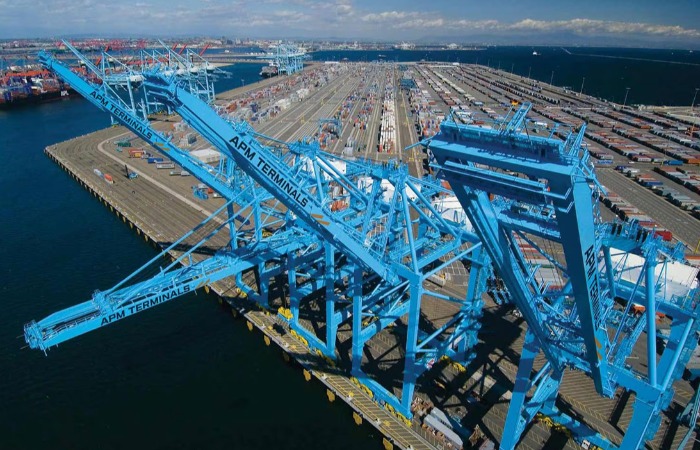
Global confidence in India’s port trajectory is also reflected in APM Terminals Pipavav’s proposed Rs 17,000 crore expansion, formalised through an MoU with the Gujarat Maritime Board. The project forms part of A.P. Moller–Maersk’s broader commitment to invest over $5 billion in Indian ports and maritime infrastructure. The Pipavav expansion will enhance container and liquid cargo handling capacity, strengthen multimodal connectivity with the Dedicated Freight Corridor and improve hinterland access to northern and western India.
APM Terminals described the investment as a long-term commitment to capacity, resilience and sustainability, aligned with India’s economic growth ambitions. The expansion is expected to generate around 25,000 direct and indirect jobs and catalyse industrial activity across Gujarat, reinforcing the link between port equipment investment and regional manufacturing growth.
Automation becomes the operating system of ports
As ports scale up, automation and digitalisation are moving decisively from pilot projects to core operating systems. DP World’s Indian operations offer a clear example of how technology is being embedded across terminals, equipment fleets and multimodal networks rather than treated as a standalone efficiency lever.
“Automation delivers real value only when embedded within a port-led ecosystem and enhances ease of doing business,” says Ravinder Johal, COO – Ports & Terminals, Operations & Commercial, Middle East, North Africa & India Subcontinent, DP World. This philosophy has shaped DP World’s approach to integrating sea, rail and road operations into a single, technology-enabled supply chain.
DP World is backing this strategy with capacity expansion at Mundra and Cochin and the upcoming Tuna Tekra mega-terminal, which will add 2.19 million TEUs of annual capacity with a 1,100-metre berth. Together, these projects will increase the company’s combined capacity in India from around 6 million TEUs to over 8 million TEUs, enabling the handling of larger vessels and higher cargo volumes.
Technology underpins this expansion. AI- and IoT-enabled systems are being deployed for terminal planning, real-time equipment monitoring, predictive maintenance and safety management. Predictive analytics is improving equipment uptime and reliability, while AI-controlled energy, lighting and inventory systems are enhancing efficiency and reducing waste. Automation is also contributing to safer operations through real-time detection of safety breaches and automated alerts.
Crucially, automation is extending beyond port gates. DP World’s network of inland terminals, free trade and warehousing zones, container freight stations, private rail operations and express logistics services is designed to connect ports directly to factories and distribution centres. This integrated approach is increasingly supporting export-oriented sectors such as automotive, EVs and electronics, aligning port equipment deployment with India’s ambition to become a global manufacturing hub.
Policy tailwinds
Alongside private capital, policy continues to play a catalytic role. The government is reworking Sagarmala 2.0 into a 10-year, Rs 75,000 crore programme expected to be taken up in the 2026–27 Union Budget. The revised framework aims to deepen state participation, avoid duplication and place greater emphasis on port modernisation, inland waterways and coastal connectivity.
The outcomes of the first Sagarmala phase demonstrate the importance of equipment-led development. Since 2015, coastal shipping has grown by over 118 per cent, while inland waterway cargo movement has increased nearly 700 per cent. These gains were enabled by targeted deployment of specialised handling equipment, dredgers, river terminals and multimodal transfer infrastructure.
Union Minister for Ports, Shipping and Waterways Sarbananda Sonowal has repeatedly emphasised the government’s focus on green, technology-led port development aligned with Make in India. Speaking on port electrification initiatives, Sonowal has stated that the objective is to promote green transport while achieving carbon neutrality across port operations, including the transition of internal logistics fleets to electric vehicles at major ports such as JNPA.
Rajiv Jalota, former Chairman, Mumbai Port Authority, has cautioned that Sagarmala 2.0 must be inclusive and sector-wide. He has stressed that lowering logistics costs is critical if coastal and inland shipping are to become truly competitive, underscoring the importance of efficient equipment deployment across major and non-major ports alike.
Heavy machines power the smart port transition
Even as automation and electrification dominate the narrative, bulk cargo remains the backbone of India’s port economy. Coal, iron ore, fertilisers, cement and other bulk commodities demand robust, high-duty machines capable of operating continuously in harsh, dusty and corrosive environments.
At ports such as Krishnapatnam, large fleets of construction equipment handle bulk cargo across stockyards, rail sidings and vessel holds. More than 170 machines from Volvo Construction Equipment are deployed at the port, including wheel loaders, excavators, compactors and articulated haulers, supporting round-the-clock operations.
“When it comes to bulk cargo handling, high uptime is critical in a port environment where every hour counts,” says Dimitrov Krishnan, Managing Director, Volvo CE India. He notes that ports are increasingly evaluating machines on lifecycle cost, fuel efficiency and service support rather than upfront price alone, reflecting the operational intensity of port applications.
Electrification is also reshaping equipment choices. India’s first all-electric tug at Deendayal Port marked a significant step towards maritime decarbonisation, while battery-powered RTG cranes and electric yard vehicles are reducing emissions and lowering lifecycle costs at container terminals. The deployment of E-Hybrid RTGs at greenfield terminals demonstrates how electrification can be scaled even where grid reliability is a concern, easing pressure on local power infrastructure.
Indian OEMs are responding to these evolving requirements. ElectroMech Material Handling Systems has been actively involved in port expansions, shipyards and dockyard modernisation, supplying heavy-duty cranes, explosion-protected equipment and digitally enabled material handling solutions. “The ports and shipping sector is seeing a clear shift from OEMs to technology providers,” says Tushar Mehendale, Managing Director, ElectroMech, reflecting how automation, telematics and remote monitoring are becoming integral to port equipment strategies.
Beyond equipment supply, after-sales support, modernisation and skill development are gaining prominence. Maintenance, refurbishment, operator training and condition monitoring are increasingly critical as ports seek to maximise asset life, improve safety and extract higher productivity from capital-intensive machines.
India’s port sector is entering what could well be described as the decade of the machine. Maritime Vision 2030 and the Maritime Amritkal Vision 2047 lay out ambitious goals—from global competitiveness to net-zero emissions at ports. Private players are committing capital at unprecedented scale, while policy is aligning infrastructure development with trade and manufacturing priorities. Ultimately, however, it is equipment—cranes, tugs, RTGs, bulk handlers, electric fleets and digital systems—that will determine whether these ambitions translate into real-world performance.
In the Rs 75,000 crore push reshaping India’s maritime landscape, port equipment is no longer a support function. It is the backbone of a logistics system that must be faster, cleaner and globally competitive. The message is clear from the OEMs, port operators, contractors and policymakers alike: the future of India’s ports will be built as much by machines as by concrete, and those who invest early in smart, green and connected equipment will define the next chapter of India’s maritime growth.