



Schedule a Call Back
Budget 2026 Charts Path for Infrastructure-Led, Tech-Driven Growth
2026-02-02
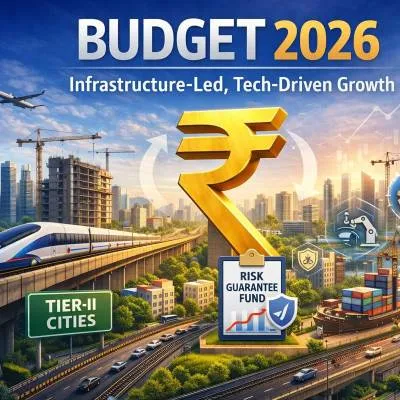
The Union Budget 2026–27 signals strong continuity in India’s macroeconomic strategy, anchored in elevated public capital expenditure, fiscal discipline, and a sharper focus on manufacturing, infrastructure, and regional development. With capital outlay pegged at ₹12.2 lakh crore and a fiscal deficit target of around 4.3 per cent, the Budget balances growth ambition with stability, offering long-term visibility to investors and project developers.
A dominant theme is the centrality of infrastructure as a multiplier for economic expansion. Public capex now accounts for over 3.3 per cent of GDP, with policymakers underlining its role in crowding in private investment, lowering logistics costs, and strengthening productivity. As Bhavesh Shah, Managing Director and Head Investment Banking, Equirus Capital, notes, “the Budget’s biggest strength lies in its predictability—building on a decade of structural reforms rather than introducing disruptive shifts.”
Infrastructure and Urban Development
The continued thrust on transport corridors, seven high-speed rail links, new dedicated freight corridors, inland waterways, and city economic regions reflects an intent to build integrated, multimodal networks. Parveen Gupta, Director, Ramacivil India, says the push to increase public capex to over ₹12 lakh crore “reflects a robust commitment to infrastructure-led growth and economic resilience,” while the Infrastructure Risk Guarantee Fund is expected to “strengthen private sector confidence and accelerate execution of large-scale projects.”
Urban development remains a parallel priority. Abhinandan Sethi, Managing Director, SPML Infra Limited, highlights that the ₹85,222 crore allocation for urban development will strengthen water supply, sanitation, transport systems and housing, enhancing liveability and resilience. The emphasis on Tier-II and Tier-III cities and emerging city economic regions is widely seen as a move to decentralise growth and create new consumption and employment centres.
Manufacturing and Industrial Competitiveness
Manufacturing is firmly positioned at the heart of India’s growth strategy. The Budget sharpens focus on electronics, semiconductors, biopharma, chemicals, capital goods and critical minerals, alongside refinements to PLI schemes. Sunil Mathur, MD and CEO, Siemens Limited, says the focus on “technology-led manufacturing, digital infrastructure such as data centres, and next-generation mobility including high-speed rail supports India’s ambition to become a global innovation and manufacturing hub.”
Several measures aim to strengthen domestic value chains. Satyen J. Mamtora, CEO and MD, Transformers and Rectifiers (India) Ltd., points to the ₹40,000 crore outlay under the Electronics Components Manufacturing Scheme and customs duty exemptions for lithium-ion battery and solar glass manufacturing inputs as steps that “provide longer-term policy visibility and may help moderate costs while supporting investments across clean as well as conventional energy infrastructure.”
Rare-earth corridors, carbon capture utilisation funding, and expansion of India Semiconductor Mission 2.0 signal movement from capacity creation toward capability building. Vedant Goel, CEO, Enlight Metals, describes the Budget as “a bold path for India’s metals and energy future,” addressing ESG challenges while securing critical mineral supply chains.
Logistics, Trade and Supply Chains
The Budget strengthens India’s logistics backbone through freight corridors, inland waterways, coastal cargo promotion and customs reforms. Dhruv Taneja, Founder & Global CEO, MatchLog, calls it a “visionary blueprint for India’s logistics backbone,” noting that measures such as dedicated REITs for CPSE asset recycling and City Economic Region funding help de-risk long-gestation projects and anchor logistics growth where demand is emerging.
At the operational level, Samarnath Jha, CEO, Accex Supply Chain Solutions, stresses that infrastructure must be complemented by predictable cargo movement. “Measures like longer duty deferral for AEOs, simpler customs warehousing and faster clearances matter because they reduce waiting—what strains cash flows for MSMEs,” he says.
Digital Infrastructure and Data Centres
Tax holidays and safe-harbour provisions for foreign cloud service providers till 2047 position India as a potential global data centre and AI hub. Anshul Jain, Chief Executive – India, SEA, MEA & APAC Office and Retail, Cushman & Wakefield, notes that these measures could “incentivise global hyperscalers and accelerate capacity build-out,” though sustained growth will depend on parallel progress in power and water infrastructure.
Clean Energy and Sustainability
Energy transition receives steady backing through support for Battery Energy Storage Systems, solar manufacturing inputs, and grid-connected renewable projects. Saurabh Marda, Co-Founder & MD, Freyr Energy, highlights that customs duty exemptions and continued support for storage systems “reinforce the government’s commitment to building a robust domestic clean energy ecosystem.”
At the same time, sustainability is increasingly positioned as an economic enabler. S. Sunil Kumar, Country President, Henkel Adhesives Technologies India, points to the ₹20,000 crore allocation for carbon capture and utilisation as a signal that sustainability is being treated “not as a compliance requirement, but as a growth driver.”
Capital Markets, REITs and Asset Recycling
Another structural pillar is capital-market deepening through REITs, InvITs and asset monetisation of CPSE real estate. Tanuj Shori, Founder and CEO, Square Yards, says this will reinforce REITs and InvITs as “mainstream investment vehicles,” expanding retail access to income-generating real assets and improving transparency and governance across the ecosystem.
Macro Stability and Outlook
Overall, Budget 2026–27 blends fiscal prudence with growth orientation. Sarvjeet Singh Virk, Co-Founder and MD, Finvasia, observes that the increase in public capex and the Infrastructure Risk Guarantee Fund reflect a strong focus on quality infrastructure and confidence in project financing, while reforms to banking, NBFCs and MSME credit access will support smaller businesses, particularly in non-metro regions.
Taken together, the Budget outlines a medium-term roadmap built around infrastructure-led growth, manufacturing scale-up, digital and clean-energy transitions, and regional development. The emphasis is less on headline-grabbing announcements and more on policy continuity and execution—suggesting that India’s next phase of growth will be shaped by sustained investment, deeper capital markets and system-level efficiency improvements.
More Reactions | Industry Voices on Budget 2026–27
Vipul Mathur, MD & CEO, Welspun Corp Ltd.
“The increased allocation to the Jal Jeevan Mission is a positive step, reinforcing the national priority accorded to last-mile water connectivity and improved access to safe drinking water across the country.”
Neeraj Balani, Chief Customer Officer, Welspun One
“The focus on City Economic Regions, Tier II and Tier III cities, and continued investment in Dedicated Freight Corridors significantly expands the opportunity landscape for institutional Grade-A warehousing and industrial infrastructure.”
Boman Irani, CMD, Rustomjee Group
“Sustaining public capital expenditure at ₹12.2 lakh crore while maintaining a credible path of fiscal consolidation underscores policy stability—an important enabler for long-gestation sectors like real estate.”
Dr Ramnath Subramaniam, Joint Managing Director, TVS ILP
“The historic ₹12.2 lakh crore capex outlay… provides the long-term capital visibility essential for private developers like us to scale industrial and logistics infrastructure.”
Harsh Pareek, Vice President, Direct Sales, Asia-Pacific, Trimble
“The continued push for advanced technologies is a positive step towards building infrastructure that is dependable, scalable and built to last.”
Manish Jain, Managing Director, Enviro Infra Engineers Limited
“The substantial increase in public capital expenditure to a record ₹12.2 lakh crore underlines a strong push for modern and integrated infrastructure development across transport, logistics, urban and water systems.”
Shishir Baijal, CMD, Knight Frank India
“The FY27 Union Budget signals continuity in India’s macro-growth trajectory, with a consistent infrastructure push and fiscal discipline.”
S. Raghav Bharadwaj, CEO & Founder, Bolt.Earth
“The significant increase in capital expenditure, sustained focus on Tier-2 and Tier-3 cities, and emphasis on scaling domestic manufacturing will give a strong boost to the EV charging ecosystem.”
Sebi Joseph, President, Otis India
“Development of city economic regions, establishment of seven high-speed rail corridors, new schemes for construction and infrastructure equipment manufacturing, proposal of infrastructural risk guarantee fund… are commendable.”
Mohit Jandu, MD, J Infratech
“The Infrastructure Risk Guarantee Fund is a pivotal reform; by mitigating construction-phase risks, it bolsters lender confidence and ensures the timely execution of mega-projects.”
Umang Bansal, Chairman, Polo Elevators
“The expansion of the Electronics Components Manufacturing Scheme to ₹40,000 crore and the introduction of the Construction and Infrastructure Equipment scheme strengthen domestic manufacturing of technologically advanced equipment.”
Vinaya Varma, Managing Director, mjunction services limited
“Focus on new dedicated freight corridors, expanded inland waterways and coastal cargo schemes are expected to improve evacuation efficiency, lower logistics costs and support offtake in bulk commodities.”
Anshuman Singh, MD & CEO, IndoSpace
“The convergence of advanced manufacturing clusters with freight corridors, multimodal connectivity, customs reform and high-speed connectivity between growth centres reinforces India’s ambition to become a globally integrated manufacturing and services economy.”
Dibyanshu Tripathi, CEO & Co-Founder, Hexalog
“The Union Budget 2026–27 comes across as clearly pro-growth, with strong emphasis on manufacturing, trade, customs, logistics, technology enablement and infrastructure.”
Abhilash Maurya, Co-Founder & CEO, Naxatra
“The increased outlay for electronics manufacturing to ₹40,000 crore and the launch of India Semiconductor Mission 2.0 will strengthen domestic production of critical components and materials.”
Dr Samantak Das, Chief Economist & Head – Research and REIS, JLL India
“Lifesciences, REITs market expansion and focus on growth sectors—education, healthcare, manufacturing, tourism and data centres—underpin a future-vision Budget document.”
Badal Yagnik, CEO & MD, Colliers India
“The overarching growth theme is evident in manufacturing scale-up, rejuvenation of legacy industrial sectors, creation of champion MSMEs and a strong infrastructure push.”
Amit Goyal, MD, India Sotheby’s International Realty
“A stable macro framework and fiscal discipline reinforce long-term confidence, especially in premium and luxury housing.”
Shrinivas Rao, FRICS, CEO, Vestian
“The Budget aims to strengthen the growth ecosystem of the real estate sector by enhancing connectivity between emerging and established urban centres and by promoting the development of economic regions.”
Divyam Shah, WTD & CFO, Euro Panel Products Ltd.
“The historic increase in Capital Expenditure to ₹12.2 lakh crore… creates massive domestic demand for modern architectural solutions like metal claddings.”
Kishan Jain, Director, Goldmedal Electricals
“The ₹12.2 lakh crore capex outlay spanning high-speed rail, freight corridors, and urban economic zones will act as a massive catalyst for the wiring, modular switch, and power systems sectors.”
Sudhanshu Vats, MD, Pidilite Industries Limited
“With public capex at ₹12.2 lakh crore, demand across housing, construction and infrastructure-linked industries will remain robust.”
Parag Munot, MD, Kalpataru Limited
“The introduction of seven high-speed rail corridors… will reduce travel times and unlock land parcels, creating new micro-markets for integrated townships.”
Satyen J. Mamtora, CEO & MD, Transformers and Rectifiers (India) Ltd.
“Customs duty exemptions for capital goods used in lithium-ion battery and solar glass manufacturing… provide longer-term policy visibility.”
Sheeshram Yadav, Managing Director, Yugen Infra
“The emphasis on public capital expenditure… is a clear indication of the government’s commitment to keeping infrastructure development at the forefront of economic planning.”
Amit Gossain, CMD, KONE Elevators India & South Asia
“The emphasis on urban development, particularly across tier-2 and tier-3 cities, will play an important role in advancing smart urbanisation and modern vertical construction.”
Union Budget
Infrastructure, real estate, steel, railways, GCC, datacentre


Subscribe Now
Subscribe to our Newsletter & Stay updated
RECENT POSTS
Popular Tags
Folliow us