


Schedule a Call Back
We are bullish on the next five years
2026-04-30
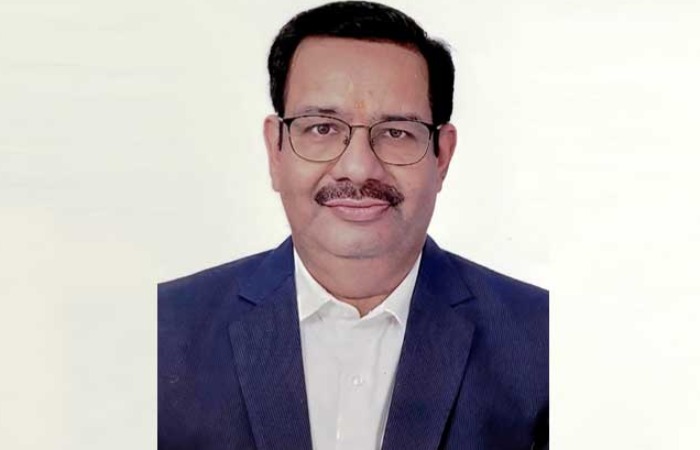
Laxmi Shukla, Asst. Vice President – Earthmoving Equipment Division, Action Construction Equipment, speaks on the outlook for the Indian backhoe loader market, and India’s potential as a global export hub.
How has the backhoe loader market performed in India over the past few years, and what are the key drivers of demand?
From where we currently sit at ACE, the Indian backhoe loader market has shown remarkable resilience and consistent growth over the past few years, and we are genuinely optimistic about where it is headed. Backhoe loaders grew 55 per cent in FY24, leading the surge in the earthmoving segment. In FY25, they accounted for 53,133 units, commanding a 54 per cent share of earthmoving equipment. Even as domestic sales softened in Q1 FY26, exports rose 34.5 per cent year-on-year, underscoring the global competitiveness of Indian-manufactured equipment.
The single biggest driver has been the government’s sustained push on infrastructure. Investments in roads, highways, irrigation networks, and urban development have created a large and consistent demand pipeline. Importantly, this is not just an urban story. Rural connectivity projects have brought mechanisation to previously underserved geographies, where backhoe loaders, given their versatility, have emerged as the equipment of choice. This inherent versatility, across both urban and rural applications, continues to anchor demand.
At the same time, customers have become more discerning. They are no longer just buying a machine; they expect telematics integration, advanced hydraulics, and operator-assist features that directly enhance productivity and reduce downtime. With increasing mechanisation, strong infrastructure momentum, and India’s push to become a global manufacturing hub, we believe the fundamentals of this segment have never been stronger.
Despite the growing adoption of specialised equipment, what factors sustain the dominance of backhoe loaders in the Indian market?
This is a question we get often, and the answer, frankly, lies in the economics and practicality of the Indian construction landscape. A backhoe loader is, at its core, a multi-tool—it excavates, loads, and handles material, all in one machine. Its popularity is driven by its versatility, mobility, and low ownership and operating costs. For most contractors, particularly small and mid-sized players who form the backbone of India’s construction sector, owning a fleet of specialised machines simply isn’t viable.
The backhoe loader solves that problem elegantly. We have doubled down on this versatility proposition by engineering machines that perform across diverse terrains and applications without compromise. Our flagship AX-124 is a fine example of this philosophy. With a 150-litre fuel tank for extended operations, a 4,000 kgf dipper tear out force, and an ergonomic cabin with 360-degree visibility, it is designed to deliver high productivity across both digging and loading without trade-offs.
Beyond the machine itself, our focus on lowering total cost of ownership, through fuel-efficient engines, durable components, and one of the strongest service networks in the country, ensures measurable lifecycle value. With growing integration of telematics and smart features, our machines continue to make a compelling case against specialisation in most real-world scenarios. The numbers reinforce this, with backhoe loaders still accounting for the majority of construction equipment sales in India—and we don’t see that changing anytime soon.
What technological advancements are shaping modern backhoe loaders, and how are they enhancing productivity and reducing lifecycle costs?
Technology is fundamentally redefining what a backhoe loader can deliver, and we are at the helm of bringing these capabilities to our customers. The most definitive shift has been the integration of telematics as our machines now give operators and fleet managers real-time visibility into performance metrics, fuel consumption, and maintenance schedules. This alone has had a measurable impact on uptime and operational costs for our customers. Beyond connectivity, advances in hydraulics have enabled greater precision and speed, while our operator-assist features reduce fatigue and the margin for human error, both of which are critical on complex, high-pressure jobsites. We have also invested heavily in ergonomics and cabin design, because we know that operator comfort directly correlates with productivity. When you combine these innovations with predictive maintenance capabilities, the total cost of ownership comes down significantly. Our customers aren't just buying a machine; they're investing in a system designed to deliver reliable performance across thousands of hours of operation.
How is customer preference evolving in terms of performance, versatility, sustainability, and total cost of ownership? What role do financing and rental models play?
The modern consumer is far more sophisticated and outcome oriented. And we view this evolution as an opportunity rather than a challenge. Performance expectations have risen sharply as customers want machines that deliver higher output, better fuel efficiency, and seamless operability across diverse conditions. Versatility remains non-negotiable, but sustainability is increasingly entering the conversation, with buyers paying close attention to emission profiles and long-term environmental impact. What has perhaps changed most meaningfully is the focus on total cost of ownership. Customers are now evaluating equipment not just on sticker price but on fuel costs, service intervals, parts availability, and resale value, and we believe ACE’s offerings perform strongly on all these parameters.
On the financing and rental front, we are seeing strong traction, particularly among emerging contractors who want access to advanced equipment without the burden of upfront capital. These models are democratising access to quality machinery and accelerating mechanisation at scale, a trend we are actively supporting through partnerships and structured financing options.
How do you assess the competitive landscape, and what strategies are manufacturers adopting to differentiate themselves?
The competitive environment in this segment is intense, with both global majors and domestic players vying for market share. But we see competition as a validation of the market’s growth potential. Our strategy has always been rooted in three pillars: product excellence, customer proximity, and the strength of our after-sales ecosystem. On the product side, we continue to invest in R&D to stay ahead on technology, whether that's through smarter telematics, more responsive hydraulics, or features that directly improve operator efficiency.
What truly differentiates us is our deep understanding of the Indian customer; the terrains they operate in, the economics they navigate, and the support they need when a machine goes down. While many manufacturers mainly focus on building dealer networks, our service infrastructure is designed around minimising downtime and maximising uptime for our customers. Additionally, our strong commitment to indigenisation aligns with the national self-reliance agenda, giving us a structural advantage in both cost competitiveness and supply chain resilience.
What are the key challenges facing the industry today, including regulatory changes, rising input costs, and the need for skilled operators?
The operating environment is definitely not without headwinds. Evolving emission norms and increasing regulatory compliance requirements demand continuous investment in technology upgrades. While these are necessary and welcome, they do add to development and compliance costs. At the same time, volatility in steel and other raw material prices remains a persistent concern, making supply chain agility critical. The most pressing challenge, however, is the shortage of skilled operators. Even the most advanced machine can only deliver its full potential when operated efficiently, and there remains a clear gap between machine capability and operator skill across the industry. We also see demand fluctuations driven by broader economic uncertainty, along with high upfront costs that can limit access for smaller contractors. Competitive intensity adds further pressure, as manufacturers balance cost optimisation with continued investment in innovation.
At ACE, we are addressing these challenges through greater localisation, stronger supply chain planning, and focused skill development initiatives. We see this not just as a business need, but as a long-term commitment to supporting India’s infrastructure growth. These challenges are real, but they are also solvable, and we are committed to being part of the solution.
What could be the cost implications of a potential US–Iran conflict on the backhoe loader industry, particularly in terms of fuel prices, logistics, and raw material costs?
Geopolitical volatility is a reality that all global industries must plan for, and we keep a close watch on developments that could impact our supply chains and cost structures. A US–Iran conflict, if it were to escalate, would most likely manifest for us through crude oil price spikes, affecting both fuel costs for end users and logistics costs across our supply chain. Fluctuations in steel and component prices could also follow, given the broader uncertainty such a conflict would generate in global commodity markets.
That said, we have been deliberately building resilience into our operations. Our indigenisation strategy reduces dependence on imports and gives us greater insulation against global supply chain disruptions. We have also diversified our sourcing and are continuously optimising logistics efficiency. The focus on fuel-efficient machines in our product portfolio isn’t just a customer benefit; it also means our equipment remains economically viable even in higher fuel price environments. We are not immune to global shocks, but we are better positioned today to absorb and navigate them than at any point in our history.
What is your outlook for the Indian backhoe loader market over the next five years, and how do you see India’s potential as a global export hub?
We are bullish on the next five years. India's infrastructure agenda shows no signs of slowing and if anything, the ambition is accelerating. The combination of sustained government capex, rising private sector construction activity, and deepening mechanisation across tier-2 and tier-3 markets creates a powerful demand environment for our segment. On the export front, we believe India's moment has arrived.
At ACE, we have built manufacturing capabilities that are globally competitive in both quality and cost. The world is looking for reliable, value-driven equipment from markets beyond the traditional Western suppliers, and India, with its engineering talent, manufacturing scale, and growing quality standards, is uniquely positioned to fill that gap. We are actively expanding our international footprint and see exports as a meaningful growth vector over the coming years. The goal isn’t just to serve India's infrastructure story; it’s to take that story global.


Subscribe Now
Subscribe to our Newsletter & Stay updated
RECENT POSTS
Popular Tags
Folliow us
Related Stories
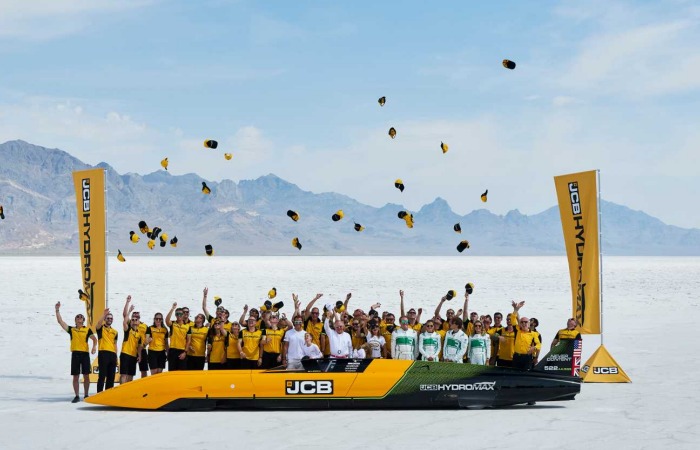
JCB Hydromax Sets Hydrogen Land Speed Record at 406.320 mph
British engineering major JCB has set a new world land speed record with its hydrogen-powered JCB Hydromax, achieving an average speed of 406.320...

Schaeffler India Names Amit Bhalerao as Chief Operating Officer
Schaeffler India has appointed Amit Bhalerao as Chief Operating Officer (COO), effective August 10, 2026. He will lead the company's manufacturin...
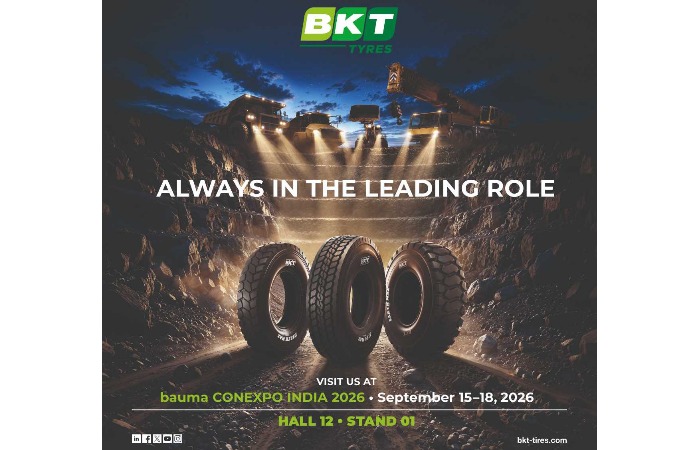
BKT to Showcase Advanced Off-Highway Tyres at Bauma ConExpo
Balkrishna Industries Ltd (BKT) will showcase its latest off-highway tyre solutions at Bauma ConExpo India 2026, scheduled from September 15-18 a...