






Schedule a Call Back
Energy Security Hinges on Resilience Amid Global Supply Shifts: S&P
2026-06-24
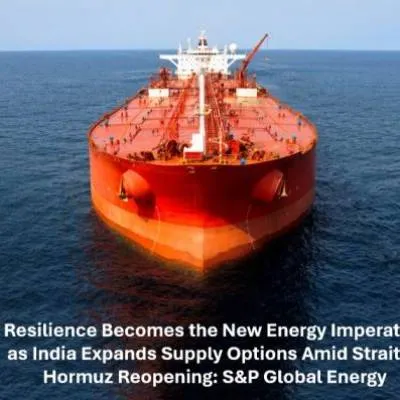
Global energy markets are undergoing a structural shift towards resilience and supply security as geopolitical uncertainties continue to reshape trade flows, according to S&P Global Energy.
Speaking at a roundtable conference in New Delhi, experts from S&P Global Energy said the reopening of the Strait of Hormuz following the June 17 memorandum of understanding between the United States and Iran is expected to support the gradual recovery of energy flows. However, they noted that market normalisation and inventory replenishment are likely to take time.
The analysis highlighted that despite the effective closure of the Strait of Hormuz resulting in a 15 million barrels per day reduction in Gulf liquids production, global energy markets demonstrated significant adaptability through inventory management, alternative supply sources and logistics optimisation.
"The effective closure of the Strait of Hormuz was the largest oil supply disruption in history. But what is surprising is the limited price reaction," said Jim Burkhard, Vice President and Head of Research for Oil Markets, Energy and Mobility, S&P Global Energy. He added that global oil inventories are expected to continue declining through June and July, potentially exerting upward pressure on prices.
According to S&P Global Energy, India's diversified sourcing strategy played a crucial role in mitigating the impact of disruptions in global liquefied natural gas (LNG) markets. Although approximately 17 per cent of global LNG supply was affected, India's LNG imports remained largely stable, declining by only five per cent and two per cent year-on-year in April and May 2026, respectively.
India diversified its LNG sourcing by increasing supplies from countries including Oman, the United States, Nigeria and Angola.
"India is expected to retain some of this diversified LNG sourcing strategy to mitigate future disruptions, potentially influencing its long-term sourcing decisions," said Johan Utama, Principal Research Analyst, S&P Global Energy.
The report also noted that global upstream markets are increasingly prioritising resource security, portfolio diversification and disciplined investment strategies. For India, long-term energy security is becoming closely linked to international upstream investments and diversified supply portfolios.
Nick Sharma, Executive Director, Upstream Energy, S&P Global Energy, said resilience is emerging as the defining metric of value for both global and Indian upstream sectors, with access to stable resources and diversified supply chains taking precedence over scale and cost optimisation.
S&P Global Energy further observed that shipping and logistics networks adapted rapidly to disruptions by rerouting cargoes through alternative maritime corridors and expanding ship-to-ship transfers, enabling Middle East crude exports to recover despite constraints on traditional trade routes.


Subscribe Now
Subscribe to our Newsletter & Stay updated
RECENT POSTS
Popular Tags
Folliow us