





Schedule a Call Back
PM-KISAN Drives Farm Income Gains And Rural Stability
2025-12-08
 The PM-KISAN scheme, a central sector initiative launched in February 2019, aims to support the financial needs of farmers holding cultivable land. Under the scheme, Rs 6,000 per year is transferred in three equal instalments to Aadhaar-seeded bank accounts through Direct Benefit Transfer. Eligibility is based primarily on cultivable landholding, with certain exclusions for individuals of higher economic status.
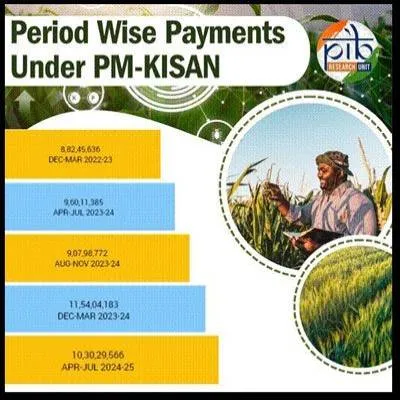
A farmer-centric digital infrastructure ensures scheme benefits reach farmers across India without intermediaries. With full transparency in registration and verification, the Government has disbursed more than Rs 4.09 trillion through 21 instalments since inception. Instalment-wise details of beneficiaries and released amounts over the past five years are provided in the annexure.
Several impact assessments underline the scheme’s contribution to farmers’ income and the broader rural economy.
(i) An independent 2019 study by the International Food Policy Research Institute (IFPRI) examined how farmers utilise the PM-KISAN transfers. It found that the funds have significantly bolstered rural economic activity, eased credit constraints and increased investment in agricultural inputs. The payments have enhanced farmers’ capacity to take calculated risks and make more productive investments. Some funds were also used for education, medical and marriage-related expenses.
(ii) Feedback gathered through Kisan Call Centres and departmental surveys indicates that more than 92 per cent of beneficiaries are satisfied with the scheme. Over 93 per cent report using the financial support for agricultural purposes.
(iii) An impact evaluation by the Development Monitoring and Evaluation Office (DMEO) of NITI Aayog confirms that PM-KISAN is effectively providing direct financial assistance to landholding farmers, strengthening their economic resilience and productivity. More than 92 per cent of surveyed beneficiaries used the support for essential inputs such as seeds, fertilisers and pesticides—particularly critical given rising input costs and increasing climate variability.
Furthermore, around 85 per cent of beneficiaries reported higher agricultural income and reduced dependence on informal credit during crop failures or medical emergencies. The study highlights the scheme’s contribution to India’s progress towards Sustainable Development Goals relating to poverty reduction, food security, gender equity and transparency. It also notes PM-KISAN’s role as a key pillar of the Direct Benefit Transfer ecosystem, with transaction failures declining sharply due to Aadhaar-enabled payments and ongoing system improvements.
This information was provided by the Minister of State for Agriculture and Farmers’ Welfare, Shri Ramnath Thakur, in a written reply in the Rajya Sabha.


Subscribe Now
Subscribe to our Newsletter & Stay updated
RECENT POSTS
Popular Tags
Folliow us