






Schedule a Call Back
Budget 2026–27 Pushes Manufacturing in Seven Frontier Sectors
2026-02-03
 The Union Budget 2026–27 places strong emphasis on scaling up manufacturing across seven strategic and frontier sectors, forming part of the six focus areas under the ‘First Kartavya’ framework. Presenting the Budget in Parliament recently, Finance and Corporate Affairs Minister Nirmala Sitharaman outlined a series of targeted interventions aimed at strengthening India’s industrial base and global competitiveness.
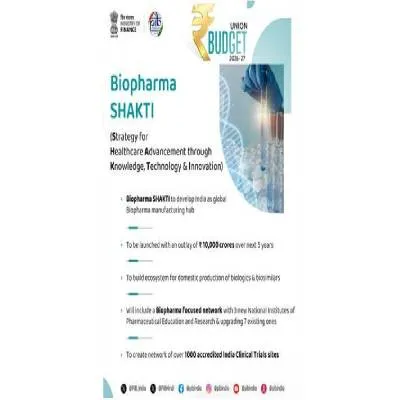
To position India as a global biopharma manufacturing hub, the Budget proposes the Biopharma SHAKTI initiative with an outlay of Rs 100 billion over five years. The programme aims to build a domestic ecosystem for biologics and biosimilars, supported by a biopharma-focused network, three new National Institutes of Pharmaceutical Education and Research, upgrades to seven existing institutes, and the creation of over 1,000 accredited clinical trial sites. The Central Drugs Standard Control Organisation will also be strengthened to meet global standards and faster approval timelines.
Building on India Semiconductor Mission 1.0, the Budget proposes launching ISM 2.0 to boost production of semiconductor equipment and materials, develop full-stack Indian intellectual property, and strengthen supply chains, with a focus on industry-led research and workforce training.
The Electronics Components Manufacturing Scheme, launched in April 2025 with an outlay of Rs 229.19 billion, will see its allocation increased to Rs 400 billion to build on recent momentum. In addition, a dedicated scheme for rare earth permanent magnets will support Odisha, Kerala, Andhra Pradesh and Tamil Nadu through the creation of specialised Rare Earth Corridors.
To reduce import dependence in chemicals, the Budget proposes supporting states to establish three dedicated Chemical Parks through a cluster-based, plug-and-play model. Strengthening capital goods manufacturing is another key thrust, with plans to set up hi-tech tool rooms through CPSEs and introduce a scheme to enhance construction and infrastructure equipment manufacturing. A separate container manufacturing scheme, with an allocation of Rs 100 billion over five years, has also been announced.
For the labour-intensive textile sector, an integrated programme comprising five sub-initiatives has been proposed, covering fibre self-reliance, cluster modernisation, handloom and handicrafts, sustainable textiles, and skilling under Samarth 2.0. The Budget also proposes setting up mega textile parks and launching the Mahatma Gandhi Gram Swaraj initiative to strengthen khadi, handloom and handicrafts with global market linkages.
Additionally, recognising India’s potential in sports goods manufacturing, the Budget proposes a dedicated initiative to promote manufacturing, research and innovation in sports equipment and material sciences.
The Union Budget 2026–27 places strong emphasis on scaling up manufacturing across seven strategic and frontier sectors, forming part of the six focus areas under the ‘First Kartavya’ framework. Presenting the Budget in Parliament recently, Finance and Corporate Affairs Minister Nirmala Sitharaman outlined a series of targeted interventions aimed at strengthening India’s industrial base and global competitiveness.
To position India as a global biopharma manufacturing hub, the Budget proposes the Biopharma SHAKTI initiative with an outlay of Rs 100 billion over five years. The programme aims to build a domestic ecosystem for biologics and biosimilars, supported by a biopharma-focused network, three new National Institutes of Pharmaceutical Education and Research, upgrades to seven existing institutes, and the creation of over 1,000 accredited clinical trial sites. The Central Drugs Standard Control Organisation will also be strengthened to meet global standards and faster approval timelines.
Building on India Semiconductor Mission 1.0, the Budget proposes launching ISM 2.0 to boost production of semiconductor equipment and materials, develop full-stack Indian intellectual property, and strengthen supply chains, with a focus on industry-led research and workforce training.
The Electronics Components Manufacturing Scheme, launched in April 2025 with an outlay of Rs 229.19 billion, will see its allocation increased to Rs 400 billion to build on recent momentum. In addition, a dedicated scheme for rare earth permanent magnets will support Odisha, Kerala, Andhra Pradesh and Tamil Nadu through the creation of specialised Rare Earth Corridors.
To reduce import dependence in chemicals, the Budget proposes supporting states to establish three dedicated Chemical Parks through a cluster-based, plug-and-play model. Strengthening capital goods manufacturing is another key thrust, with plans to set up hi-tech tool rooms through CPSEs and introduce a scheme to enhance construction and infrastructure equipment manufacturing. A separate container manufacturing scheme, with an allocation of Rs 100 billion over five years, has also been announced.
For the labour-intensive textile sector, an integrated programme comprising five sub-initiatives has been proposed, covering fibre self-reliance, cluster modernisation, handloom and handicrafts, sustainable textiles, and skilling under Samarth 2.0. The Budget also proposes setting up mega textile parks and launching the Mahatma Gandhi Gram Swaraj initiative to strengthen khadi, handloom and handicrafts with global market linkages.
Additionally, recognising India’s potential in sports goods manufacturing, the Budget proposes a dedicated initiative to promote manufacturing, research and innovation in sports equipment and material sciences.


Subscribe Now
Subscribe to our Newsletter & Stay updated
RECENT POSTS
Popular Tags
Folliow us